
Over ten years ago, I had to pick a name for my garlic farm. I read several articles on it, and one definite rule was “never use a non-English name, and if you do, definitely don’t pick something that’s hard to pronounce.” Being of Irish heritage, I take direct instructions from authorities as indirect invitations to be contrary- so I named my farm in Irish Gaelic, and to boot, made sure it was hard to pronounce. My goal was to prove that real, meaty content, in the form of unique writing and embracing one’s own voice, would supply better results than being conformist.
Sure enough, the first site succeeded in finding my tribe, and I plan on seeing this one do the same. You will NOT find this place because it was a widely-searched term- you’ll find it because you know me personally in one form or another, or seek the same things or ask the same questions that I do. I’m confident my “tribe” is bigger than I may think and it’s worth the risk to seek it.
With similar gusto and aplomb, I’ve selected the name for this blog. I’ve had it in mind for months and months, and even as I workshopped English alternates, I couldn’t get over how nice the Irish alliteration worked. I also couldn’t get beyond how pretentious the wandering farmer felt in English, or the playfully-unpretentious-but-actually-more-pretentious a wandering farmer may sound. I’ll use the English in subtitles or chapter titles but I couldn’t bring myself to title the site itself that way.
Nowadays, we play silly games, like non-capitalization of names to make them more accessible- it’s like the cowardice of putting no dollar sign near prices on menus, like all the most expensive places do. It rings hollow, in our world awash with self-promotion and with our habitual hiding of flaws.
For feirmeoir fánach, a simple translation is “wandering farmer,” but what is fun about the Irish word fánach is its abundance of meanings. Google Translate will spit out “trivial,” while the community-respected online dictionary teanglann.ie shows the true richness of options (interestingly, ranking “trivial” as one of the least-used options). It does suggest wandering, random, vain, migratory, aimless, stray, casual. 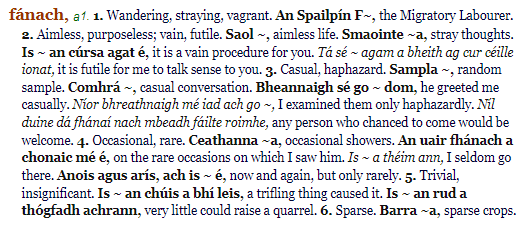
(from https://www.teanglann.ie/ga/fgb/f%c3%a1nach)
It contains variants with both negative connotations and with neutral. I wonder if it was some sour linguist at Google who, frustrated with Irish’s slipperiness, decided to peg “trivial” on it because it represented everything he hated. The definition and translation of fánach is, itself, quite fánach. I enjoy the word because it can be a Rorschach Test of how you, or I, may feel about the word after it.
At its core, fánach is an adjective clearly cut from the verb root fán, which is to stray or wander, which reveals its core origins. Seeing the number of set phrases playing with the root, you can tell that Irish has an affection for all the implied meanings of fán, fánach, and its kin. The psychology of Irish life created much an occasion for it- a psyche that seeks justice, seeks a cause, seeks something worth fighting for, and can be psychologically distressed or broken when it’s not found. You can be fánach precisely because you’ve found an aim and the aim requires mobility, or because you have no aim at all.
Thus I describe, in some ways, my own journey. I’ve hit the road precisely because I have purpose, but what I love is how random it can seem to some on the sidelines. I am wandering, vagrant, migratory. I have (fairly casually) agreed to big things on short timelines that have propelled me to crazy places I hadn’t imagined being.
In the opposite vein, I’ve had several people hear of my gap year and say, quite quickly, “oh that’ll be perfect on your CV / resume for the next step.” They just can’t imagine that it’s as random as it is, and they construct a narrative to make sense of it. That’s perfectly fine. It’s wrong, but it’s fine. It’s a common byproduct of our evolution as a species- we remember things better as stories. We create protagonists, antagonists, themes, because it was more helpful than harmful most of the time. But, for me, shrinking things down to a story with a plotline removes the complexity or randomness, and for someone who loves both complexity and randomness, this is a sin.
I’ll go back in time and write some posts about the start of this to catch people up, but the basic gist is that I left my normal life seven months ago, to volunteer abroad. I was specifically wanting to contribute to helping Ukrainians in the face of the Russian invasion of Ukraine. That is still a main focus of mine, but while I was abroad, the earthquake in Turkiye and Syria occurred. I have a long personal connection to Turkiye, and so worked to get myself there. In between and after, I saw old friends and made new ones, through Portugal, Spain, Ireland, and the UK. I’m on a two month break in the US to see family and friends, and I’ll be returning to both those causes. I’m calling this my “gap year,” though not taken at the usual time in life, and with no actual planned endpoint. In fact, it had no planned start point, because it wasn’t a whole year when it started. It’s a convenient shorthand for a unique point in life. It’s the University of the Road- where I explore goals, values, and opportunities to do good things for people and ideas that I care about.
My next actions may appear wandering, random, etc, but they are anything but. I can’t contribute to every single cause or need, but there are at least two that are closest on my mind and I’m working to do what I can in them. I suspect that more things will come up, and the scope of what I’m doing may increase, but I’ll leave that for the next “me” to handle- the me of that moment in time.

 The Wandering Farmer (an feirmeoir fánach)
Leave a reply to Linda Cancel reply